
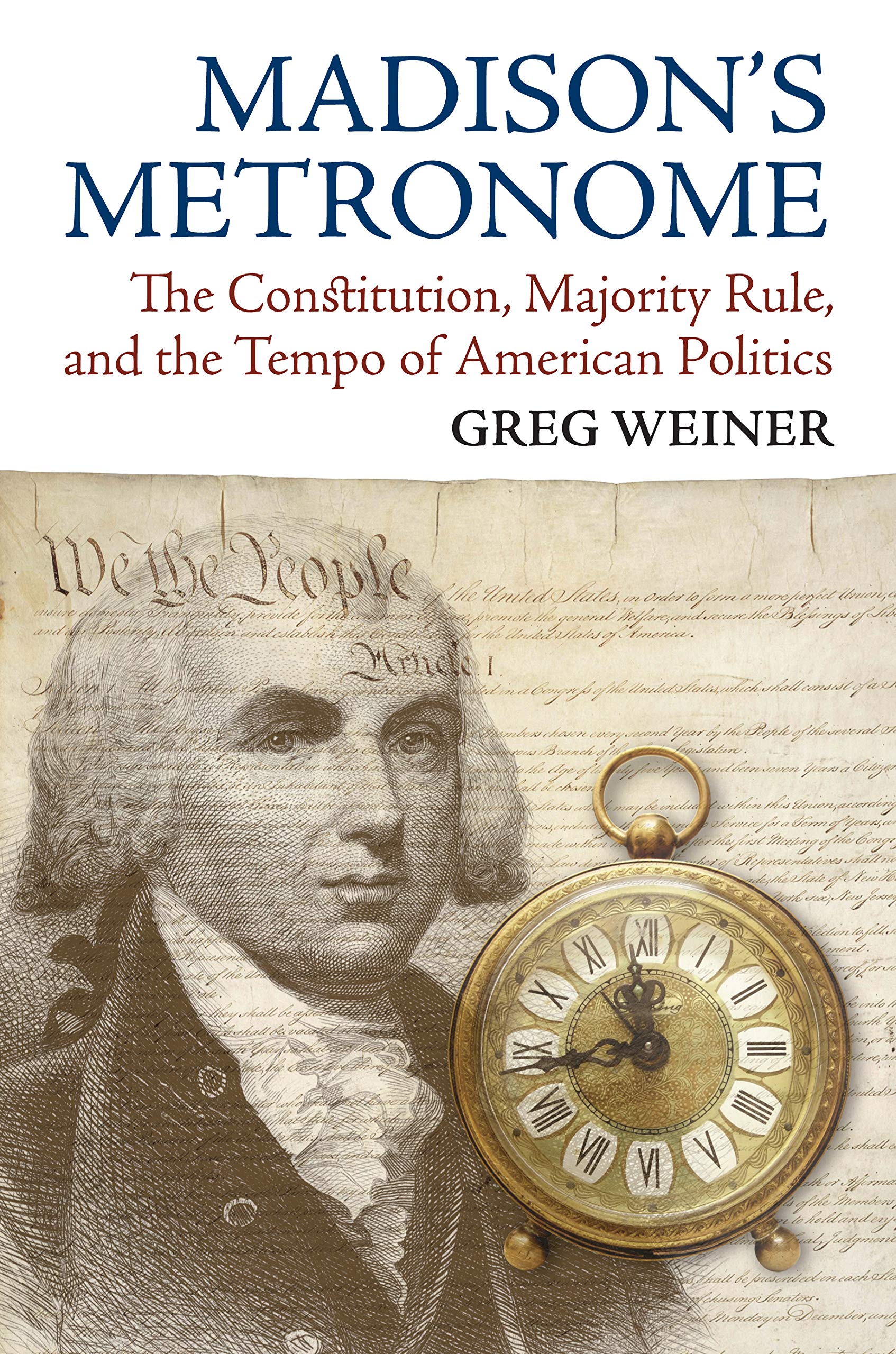
Madison's Metronome: American Politics and the Tempo of Majority Rule
Related Products


Worth:
points
-
Particulars
)

Greg Weiner challenges the traditional notion that Madison was wary of majority rule. Instead, Weiner asserts that Madison viewed constitutional structures as tools to delay decisions until public passions subsided and reason prevailed. Essentially, Madison believed that the Constitution served as a metronome, regulating the pace of American politics.
Weiner refers to this implicit doctrine as "temporal republicanism" to highlight its compatibility with, yet distinction from, other interpretations of the Founders' ideals. Similar to civic republicanism, the "temporal" concept embodies values such as public-spiritedness and respect for others' rights, which go beyond mere majority rule. Through an exploration of Madison's extensive career, Weiner reveals that Madison's understanding of internal constitutional checks and his renowned "extended republic" argument served as mechanisms to enhance majority rule by slowing it down rather than obstructing it. Changes in Madison's perspective on majority rule were largely influenced by his evolving views on impulsive behavior, whether from abusive majorities in the 1780s, the Adams administration in the 1790s, or the nullifiers in the 1820s. Despite these shifts, there is no evidence that Madison's fundamental beliefs regarding majority rule or the fleeting nature of passions ever wavered.
In Madison's time, endurance was crucial due to slow communication and travel. Nowadays, with the Internet, 24-hour news, and instant gratification politics, cultivating endurance is even harder. While many modern politicians prioritize impatience over constitutional principles, Madison's Metronome suggests that this prominent figure from American history would likely approach this marriage cautiously.
User Reviews


There are no reviews yet.